Buying Land In Brock: Key Steps Before You Build
June 25, 2026
June 25, 2026
Dreaming about building in Brock? A pretty tract can be exciting, but land value and buildability are not always obvious at first glance. If you want to buy smart, you need to know which rules apply, how water and septic will work, and whether access is truly ready for a future home. This guide walks you through the key steps to check before you close so you can move forward with more clarity and fewer surprises. Let’s dive in.
Brock is not just a typical neighborhood lot market. Current listings show everything from very small parcels under a quarter acre to large tracts over 100 acres, with many options falling in the 1 to 6 acre range and others in the 20 to 100-plus acre range. That makes Brock more of an acreage and ranchette market, where each property can come with a very different set of questions.
That variety is part of the appeal, but it also means you cannot assume one tract works like the next. A parcel that looks ideal for a custom build may still need answers on jurisdiction, utilities, access, platting, and site conditions. In this part of Parker County, the details matter.
One of the first things to verify is whether the property is inside the Town of Brock or in unincorporated Parker County. A Brock mailing address does not answer that question by itself. The rulebook can change depending on where the tract actually sits.
The Town of Brock says it incorporated in 2016 and maintains ordinances plus planning and zoning functions. Parker County, on the other hand, says there are no zoning requirements in unincorporated areas and that the county does not issue building permits or certificates of occupancy there. That difference can affect what you can do with the land and how your build process unfolds.
This is one reason land buyers benefit from local guidance early. In Brock, two properties that seem similar on paper can fall under very different requirements.
Growth trends can shape your land decision, especially if you are thinking about long-term value. Parker County’s 2023 transportation plan says the county grew more than 34.1% from 2010 to 2022 and was growing at 4.8% per year. That kind of growth can influence roads, demand, commute patterns, and future development around your tract.
It is also worth comparing cost structures between properties. The Town of Brock says it provides municipal services without levying a town property tax. Depending on whether a tract is inside town limits or outside them, that may be one factor in your long-term ownership costs.
If school assignment matters to your household, verify it early in the process. Brock ISD covers about 105 square miles and has five campuses, so buyers often confirm school assignment as part of their due diligence.
Water is one of the biggest land questions in the Brock area. Parker County Special Utility District says its original purpose was to provide water to rural areas including Brock, Dennis, Greenwood, and areas near Millsap and Bennett. Some tracts may have access to a public water provider, while others may depend on a private well.
Private wells are a major part of this market. The Texas Water Development Board says Parker County had about 8,000 domestic wells drilled from 2005 to 2020, more than any other county in Texas during that period. It also says many local housing subdivisions rely on private wells as their sole water source.
That means you should ask direct questions before you buy:
If a tract uses an existing private well, or if you are evaluating an area where wells are common, early testing matters. The Texas Water Development Board says the state does not regulate private well water quality, which means the owner is responsible for addressing any issues.
Its guidance also notes that testing can range from a basic bacteria screen to a more complete standards analysis that may cost a few hundred dollars. In practical terms, that means well quality is not something to guess about. If water will be part of your plan, get the facts early.
If the property is in unincorporated Parker County and not connected to a sewer system, you will likely need an on-site sewage facility. Parker County regulates these systems in the unincorporated area, and the county’s permit guidance requires state-approved forms, a site and soil evaluation, and a copy of the plat or a land survey showing the legal description and lot size.
The county also says no physical parts of a system may be installed until approval has been confirmed. That is important because a beautiful homesite is not automatically a septic-ready homesite. Soil and site conditions can directly affect whether and how a system can be approved.
This is a smart place to slow down and verify feasibility before you commit to a builder timeline. Septic planning is not usually the glamorous part of buying land, but it is one of the most important.
Parker County also says it regulates development in special flood hazard areas in unincorporated Parker County. If part of a tract falls within a flood-prone area, that can affect where you place a home, driveway, septic system, and other improvements.
Do not rely only on how dry the property looks on the day you visit. Land that feels usable at first glance may still come with development limits tied to drainage or flood hazards. This is another item to verify before closing, not after.
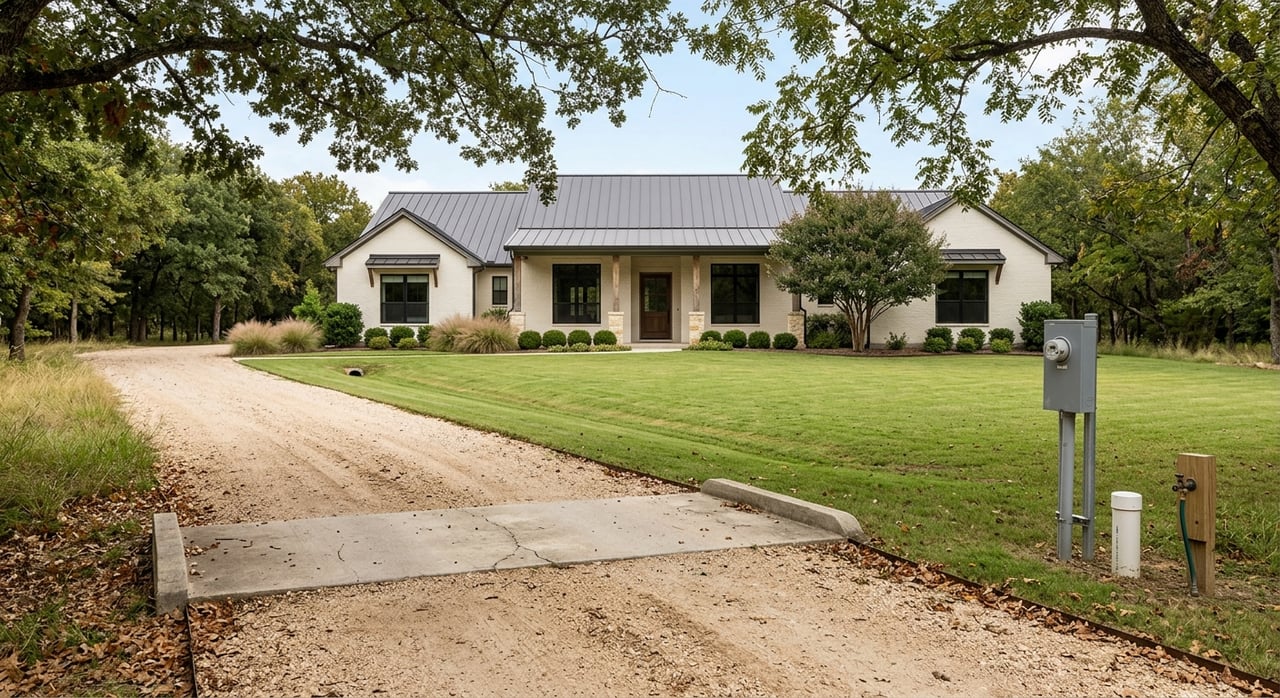
Access is more than seeing a gate and a gravel drive. Parker County’s 911 Addressing application says rural addresses are determined by driveway location, and if the driveway changes, a new address may be required. The application also says buyers should submit a survey and site plan, and if access crosses another person’s property, a right-of-way grant is required.
If the entrance opens onto a state road, TxDOT approval must come first. Those details matter because legal access, driveway placement, and address setup can all affect your build plan.
There is also the question of road maintenance. Parker County says not all roads are county-maintained. Some are private, some are inside incorporated towns, and state highways and FM roads are maintained by TxDOT. Before you buy, it is wise to confirm who maintains the road serving the tract and what that means for day-to-day use.
A driveway entrance may require more than clearing a path. Parker County requires a culvert permit for driveways and entrances, and the county says unpermitted culverts can be removed at the owner’s expense.
That may sound like a small detail, but it can become a very real cost and delay if missed. When you are planning access improvements, make sure the driveway and culvert plan lines up with county requirements.
Not every parcel is ready for your exact plan on day one. Parker County’s subdivision rules outline separate processes for new plats, replats, and metes-and-bounds revisions. The county also notes a specific submission schedule for platting materials.
For buyers, the takeaway is simple: lot splits, boundary changes, or creating a new subdivision are not casual steps. If your plan depends on changing the tract configuration, verify that process before you close, not after.
Once the land checks out, the builder side matters just as much. The Texas Attorney General recommends asking for references, avoiding low-ball bids, confirming credentials for licensed trades, and insisting on a detailed written contract that clearly spells out scope, materials, timing, and payment terms.
It also warns against signing blanks or rushing into a contract. In a custom-build setting, that advice is especially valuable. A strong tract can still become a stressful project if the builder relationship is not handled carefully.
Warranty language can also confuse buyers. The Federal Trade Commission says a builder warranty usually comes with new construction and generally covers workmanship and materials, while a home warranty is a separate service contract that costs extra.
The same guidance recommends making warranty claims in writing and keeping records of correspondence. When you build, clear documentation matters almost as much as the warranty itself.
Before you buy land in Brock, try to confirm these items:
In Brock, the biggest risks are often the ones you cannot see from the gate. Jurisdiction, well planning, septic feasibility, access rights, and builder coordination can all shape whether a tract is truly ready for your vision. That is why buying land here calls for more than a quick showing and a good first impression.
If you are considering acreage, ranchettes, or a custom home site in Brock or the surrounding Parker County area, working with a local brokerage that understands land and new construction can help you ask better questions from the start. To talk through your goals and the details behind a tract, reach out to Ivy House Realty.
Stay up to date on the latest real estate trends.
We pride ourselves in providing personalized solutions that bring our clients closer to their dream properties and enhance their long-term wealth.